
| Sourcing Strategy / Strategy Feature | Primary Reseller Advantage | Typical Profit Margin Target | Risk Level |
|---|---|---|---|
| Typo & Misspelling Sweeps | Finds unlisted items hidden from standard search bars | 40% – 100%+ | Low |
| Instant Buy-It-Now Alerts | Catches severely underpriced listings within seconds of posting | 50% – 200% | Low |
| Zero-Bid Auction Sniping | Secures items at low opening bids without triggering bidding wars | 30% – 70% | Medium |
| Cross-Marketplace Comps | Prevents overpaying by cross-checking multi-channel pricing | Risk Mitigation | Very Low |
If you have ever refreshed an eBay search only to watch a $300 vintage jacket sell for $35 on a Buy-It-Now listing, you know the frustration. The top tier of full-time resellers do not sit around manually clicking refresh on search bars all day. Instead, they run an automated deal finder ebay strategy that continuously sweeps millions of active listings, catches mispriced steals, and sends immediate alerts before anyone else notices.
Whether you are flipping pre-owned items full-time or looking for consistent weekend profit, high-margin sourcing comes down to speed and search precision. According to eBay Inc., the platform maintains over 132 million active buyers globally, making it one of the largest marketplace hubs on earth. Where there is massive buyer and seller volume, there is human error. Everyday sellers misspell product titles, miscategorize rare items, and launch zero-bid auctions at 2 AM. In this guide, I will break down how to leverage an ebay deal finder tool to automate your search and claim these margins before other flippers even know they exist.
What Is an eBay Deal Finder and Why Is It Essential for Resellers?
The Mechanics of eBay Arbitrage Sourcing
Online arbitrage relies on exploiting price discrepancies between what an uniformed seller lists an item for and what true fair market value dictates. An eBay deal finder acts as a continuous background monitor. It pulls listing metadata—such as title terms, category IDs, price thresholds, and purchase formats—and cross-references them against your specific profit criteria.
Rather than waiting for eBay's standard search engine to index listings into broad search results, advanced sourcing tools scan raw listing feeds. This enables flippers to spot pricing anomalies seconds after a seller clicks "Publish."
Why Manual Searching Leaves Money on the Table
Manual search queries on eBay are inherently reactive. By the time you type "vintage stereo receiver" into the search bar and sort by "Newly Listed," a savvy reseller using real-time search triggers has already bought the underpriced listing.
Manual searching also restricts your deal flow to the exact hours you spend sitting in front of a screen. You miss out on the 24/7 stream of inventory posted overnight, during work hours, or during peak commuting times when casual sellers like to clear out their closets.
How Automation Gives You an Unfair Advantage
Automated tools level the playing field. Instead of endlessly clicking refresh, automated search systems and API integrations deliver push notifications straight to your mobile device or desktop within milliseconds of a mispriced listing going live.
This structural advantage shifts your daily workflow from searching for items to simply evaluating deal metrics and clicking "Buy Now."
How Does a Deal Finder eBay System Spot Mispriced Listings?
Uncovering Typos and Misspelled Titles
One of the easiest ways to find ebay mispriced listings is by targeting spelling mistakes. Search engines inside major marketplaces rely heavily on exact text matching or standard lexical corrections. If an inexperienced seller lists an "ipone" instead of an "iPhone," or posts a "Leica camera" as a "Leca camera," standard buyer searches skip over the listing entirely.
A proper deal finder setup routinely scans for hundreds of known brand typos, isolating listings that receive zero organic search impressions due to bad titles.
Targeting Newly Listed Buy-It-Now Steals
Sellers clearing out estate items, garage clutter, or unwanted gifts often value fast cash over maximum margin. They will list an item worth $500 for $50 under Buy-It-Now simply to guarantee a quick sale.
These underpriced listings rarely stay active for longer than two to three minutes. A robust deal finder ebay setup captures these listings instantly, allowing you to check sold comps and complete the checkout before competing flippers open their browser.
Pro Tip: When setting up Buy-It-Now alerts, always filter out listings from sellers with zero feedback who are shipping from overseas. This simple rule eliminates 95% of scam listings and fake inventory.
Exploiting Zero-Bid Auctions Ending Soon
Auction listings with zero bids scheduled to end within 15 minutes are a goldmine for resellers. Why do high-value items end up with zero bids? Usually because the seller:
- Used a vague, single-word title.
- Listed the item in an irrelevant sub-category.
- Set the auction ending time for an off-peak hour (like 3:00 AM on a Tuesday).
By targeting zero-bid auctions right before close, you can place single-bid snipes that win high-value items for rock-bottom opening prices.

What Are the Most Effective Strategies for eBay Arbitrage Sourcing?
Cross-Marketplace Price Tracking for Flippers
Profitable flipping is not limited to buying and reselling on eBay alone. Many of the best deals come from cross-marketplace arbitrage—buying mispriced goods on eBay and listing them on local or niche platforms, or vice-versa.
Consumer demand and pricing fluctuate wildly across platforms. Research from Statista shows that the US secondhand market is projected to reach over $80 billion by 2027. Tapping into this market requires systematic ebay price tracking for flippers to establish baseline values across platforms so you can buy low on one channel and sell high on another.
+-------------------------------------------------------------------+
|                  CROSS-MARKETPLACE FLIPPING FLOW                  |
|                                                                   |
|  [ eBay Deal Finder ]  ---> Identifies Mispriced Item ($40)       |
|                                         |                         |
|                                         v                         |
|  [ Sold Comps Check ]  ---> Verifies True Market Value ($180)     |
|                                         |                         |
|                                         v                         |
|  [ Instant Purchase ]  ---> Buy-It-Now / Last-Second Snipe        |
|                                         |                         |
|                                         v                         |
|  [ Multi-Channel ]    ---> Resell on FB Marketplace / Mercari     |
+-------------------------------------------------------------------+
Focusing on Niche and High-Margin Categories
Not all product categories yield equal returns. Fast-moving commodity items like current-gen video games or popular smartphones have razor-thin profit margins and intense competition. To maximize your return on effort, focus on high-margin, inefficient categories:
- Vintage Apparel & Streetwear: Misidentified vintage single-stitch tags, rare band tees listed as generic shirts, and 1990s outerwear.
- Industrial & Power Tools: Heavy machinery replacement parts, discontinued power tool bodies, and commercial test equipment.
- Retro Electronics: Analog audio receivers, cassette decks, vintage gaming consoles, and working CRT monitors.
- Collectibles & Estate Lots: Unsorted trading card balance lots, estate jewelry bundles, and vintage toys.
Leveraging Historical Sales Data for Price Validation
Never rely on current active asking prices to estimate your potential profits. Anyone can list a broken appliance for $1,000; that asking price reflects seller optimism, not market reality.
Successful ebay arbitrage sourcing relies entirely on "Sold & Completed" historical comp data. Before purchasing inventory, subtract platform fees, payment processing costs, inbound shipping, and estimated outbound shipping from the average sold price over the last 90 days to calculate your true net profit margin.
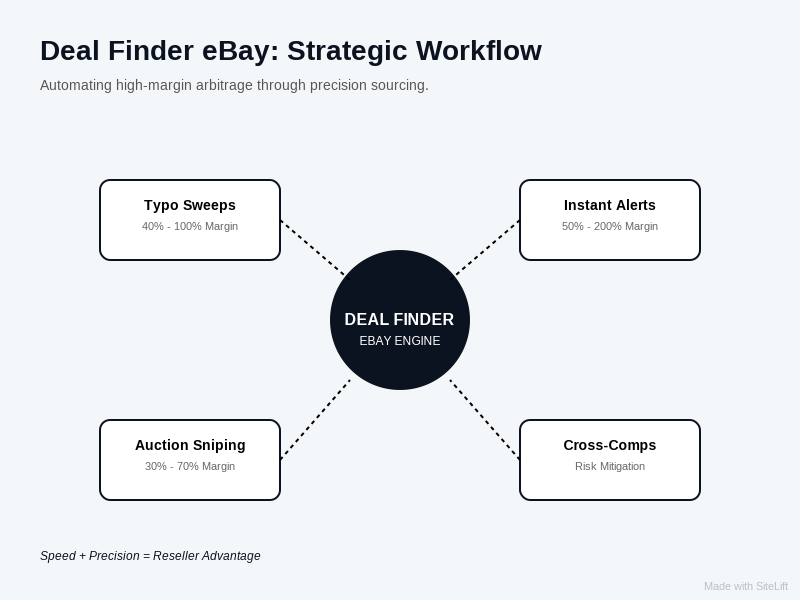
Infographic by SiteLift
Which Features Make the Best Deal Finder eBay Setup for Resellers?
Real-Time Push and SMS Notifications
When an underpriced Buy-It-Now item hits the market, every second counts. Traditional email alerts are often delayed by several minutes, which means you lose the purchase to someone faster. Look for tools that send instant desktop pushes or direct mobile notifications.
Custom Filter Granularity (Condition, Location, Price Range)
A good search filter acts as a fine mesh sieve. You need the ability to filter out non-working or "parts only" items (unless you specialize in refurbishing), along with listings that carry excessive international shipping costs.
Custom filter parameters allow you to mandate minimum seller feedback scores, specific item condition tags, total delivered price thresholds, and seller location filters (such as US-only sellers to avoid long delivery delays).
Multi-Platform Aggregation Capability
Sourcing inside a single platform limits your potential deal volume. While eBay offers massive global scale, local marketplaces like OfferUp or Facebook Marketplace often feature even steeper discounts from casual sellers who prefer quick local cash pickups.
Using unified tools—like the Find & Flip Extension—enables you to compare eBay sold comps instantly while browsing local marketplace deals, giving you immediate context on whether an item is worth picking up.
How Can You Snag Undervalued Auctions Before Other Resellers Do?
Setting Up Precision Saved Searches and RSS Alerts
To create high-intent search triggers, combine Boolean search operators inside your search queries. Use terms like (misspell, misprint, rare, estate, untested) alongside specific model numbers to surface hidden listings.
For example, a search string like Sony (STR, receiver) vintage -broken -parts isolates actual vintage audio equipment while stripping out salvage items listed for repair.
Mastering Last-Second Sniper Bidding
Bidding early on an eBay auction is a costly beginner mistake. Placing early bids signals demand to rival resellers, driving up the price and ruining your target profit margins.
Instead, use auction sniping tools or set dedicated reminders to submit your single maximum bid within the final 3 to 5 seconds of the auction. This tactic leaves competing bidders no time to react or counter-bid.
Pro Tip: When placing a last-second auction snipe, use odd cent amounts (like $47.37 instead of $45.00). Resellers often bid round numbers, and those extra few cents can frequently win you the auction.
Negotiating Best Offers on Stale Inventory
Listings that have been active on eBay for more than 14 to 30 days represent motivated inventory. Sellers sitting on dead stock often grow tired of paying storage costs or waiting for full asking price.
Filter your targeted searches by items offering the "Best Offer" feature and submit respectful, reasonable offers on aging listings. A fair offer equal to 60% to 70% of the asking price frequently gets accepted by sellers eager to clear out shelf space.
Why I Prioritize Combining Online Comps with Local Sourcing
In my years of active flipping, I have seen hundreds of resellers get hyper-focused on pure, online-only arbitrage. While grabbing mispriced items directly off eBay is profitable, the single largest profit margins come from combining online market comp data with local sourcing.
According to the ThredUp Resale Report, 3 out of 4 consumers are open to purchasing secondhand goods. The sheer volume of pre-owned merchandise being sold locally by non-professional sellers is massive. When a neighbor lists a vintage leather jacket on Facebook Marketplace or OfferUp for $10 because they do not know its market value, that is where 500%+ profit margins happen.
My golden flipping rule is straightforward: Use online marketplaces as your pricing authority, but use local platforms as your primary inventory engine.
By utilizing real-time deal evaluation software like Find & Flip, you can spot a local bargain, verify what it sells for on eBay within seconds, acquire the item locally, and list it for full market value nationwide.
Turn Sourcing Speed Into Predictable Resell Profits
Sourcing profitable inventory manually is slow, repetitive, and inconsistent. If you want to scale your reselling business without spending 10 hours a day refreshing search tabs, you need automated tools built specifically for flippers.
At findandflip.io, we built our comprehensive reseller suite to eliminate guesswork from deal finding. Whether you are hunting for underpriced local items or verifying national comp data, our tools aggregate mispriced listings, provide fair market value estimates, and score deal profit potential in real time.
If you want to streamline your setup, explore our reseller FAQ guide to learn how to automate your daily deal pipeline.
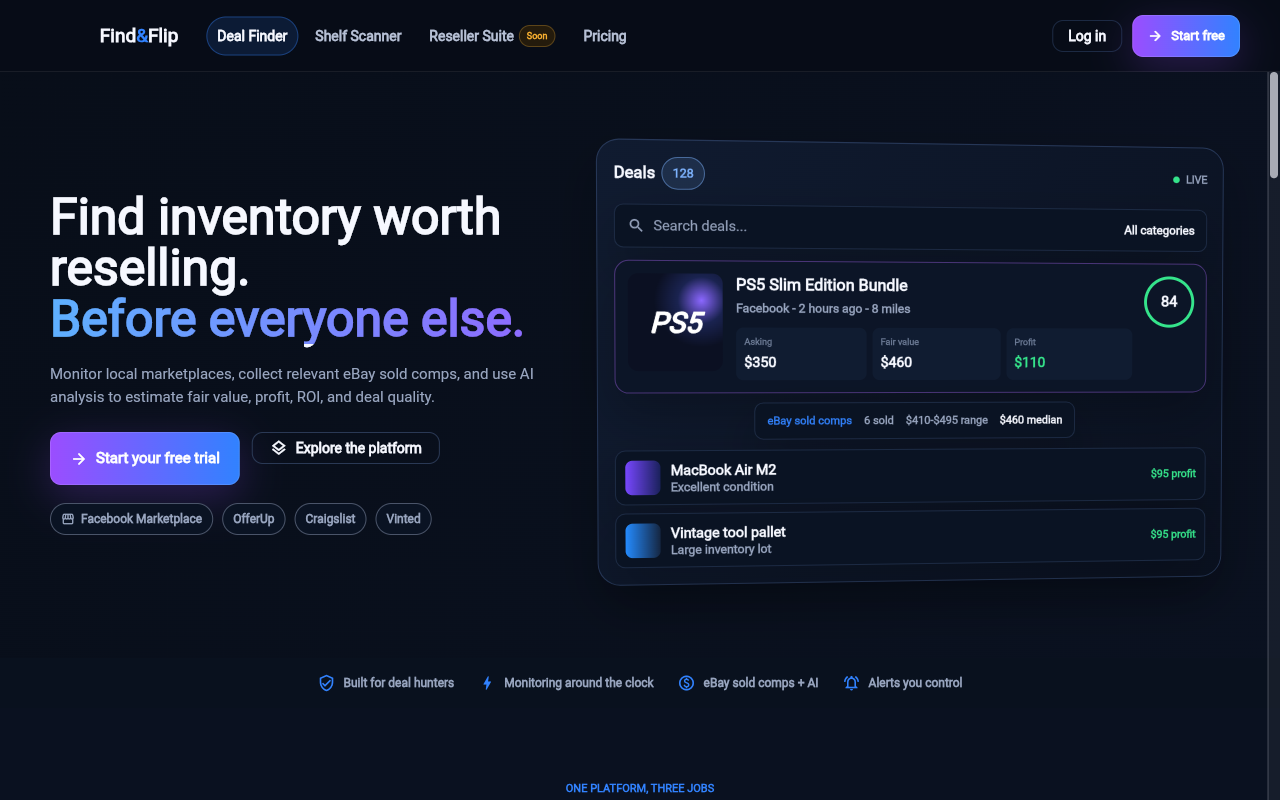
— findandflip.io
FAQ
What is an eBay deal finder tool?
An eBay deal finder tool is a specialized software application or browser extension that continuously monitors marketplace listings. It scans titles, prices, categories, and formats in real time to alert resellers to mispriced items, misspelled titles, and zero-bid auctions before the broader market finds them.
How do resellers find misspelled listings on eBay?
Resellers find misspelled listings using automated typo-search tools or custom search strings that deliberately include common spelling errors (such as "Samsng" instead of "Samsung"). Because eBay's standard search engine often fails to match these typos with generic buyer queries, these listings receive fewer views and bids, making them ideal targets for low-cost purchases.
Is online arbitrage on eBay legal and compliant with platform rules?
Yes. Buying an item on eBay to flip on another platform (or buying on another site to resell on eBay) is completely legal and complies with marketplace policies. However, resellers must adhere to standard seller policies, accurately represent item conditions, and manage their own shipping and customer service.
How fast do you need to act on a mispriced Buy-It-Now listing?
For severely underpriced items (such as goods listed at 80% below fair market value), you usually need to act within 30 to 90 seconds. High-margin Buy-It-Now listings are routinely targeted by multiple resellers using automated notification tools.
Can you use an eBay deal finder to source products for cross-listing on other platforms?
Absolutely. Many professional resellers use eBay deal finders specifically to source undervalued inventory that they can cross-list on platforms like Facebook Marketplace, Mercari, Poshmark, or specialized niche marketplaces where buyers pay premium prices for specific item categories.