
If you have spent any time flipping goods locally, you know the drill: opening Facebook Marketplace, refreshing OfferUp, typing the same five search queries into Craigslist, and squinting at grainy photos. By the time you spot an authentic Herman Miller chair listed for $50, someone else picked it up ten minutes ago. Manual sourcing is exhausting, inefficient, and fundamentally broken.
Deploying an AI deal finder changes the entire equation. Instead of spending three hours a day glued to your screen praying for an underpriced gem, an AI deal finder acts as your autonomous sourcing agent—monitoring platforms 24/7, appraising values against live market comps, and pinging your phone the second an asymmetric arbitrage opportunity appears.
Whether you flip designer clothing, mid-century modern furniture, or vintage stereo gear, automation is no longer optional. It is the dividing line between casual hobbyists making beer money and serious operators building predictable, five-figure monthly resale businesses.
What Is an AI Deal Finder and How Does It Work?
At its core, an AI deal finder is specialized software that combines web scraping, natural language processing (NLP), and computer vision to monitor peer-to-peer marketplaces. It continuously evaluates new listings against historical sales data and alerts you to underpriced inventory in real time.
Unlike simple search notification tools that trigger on basic text matches, an AI deal finder understands context, identifies value signals, and estimates profit margins before you ever tap on the listing.
+-----------------------------------------------------------+
|               Marketplace Ingestion Engine                |
|   (FB Marketplace, Craigslist, OfferUp, Vinted, etc.)     |
+-----------------------------+-----------------------------+
                              |
                              v
+-----------------------------------------------------------+
|                   AI Intelligence Layer                   |
|  - NLP: Parses misspellings, vague text & hidden specs    |
|  - Computer Vision: Identifies brands & models from pics  |
|  - Real-Time Comps: Checks eBay sold listings & pricing   |
+-----------------------------+-----------------------------+
                              |
                              v
+-----------------------------------------------------------+
|                   Profit & Margin Filter                  |
|       (Filters by Net Spread, Margin %, Pickup Radius)    |
+-----------------------------+-----------------------------+
                              |
                              v
+-----------------------------------------------------------+
|              Sub-Minute Omnichannel Alerts                |
|               (Push, SMS, Telegram, Discord)              |
+-----------------------------------------------------------+
From Manual Refreshing to Machine Learning Scraping
Traditional flippers rely on saved searches inside native apps. These native systems fail for two reasons: they are painfully slow—often batching notifications hours after an item goes live—and they only understand exact text queries.
Modern AI flipping tools continuously parse marketplace feeds via headless browser instances and private APIs. When a motivated seller lists a moving sale in your zip code, the machine learning engine ingests the data within seconds. It instantly matches the asking price against recent comps on platforms like eBay and Mercari, performing automated deal calculations to see if the spread meets your criteria.
Natural Language Processing (NLP) for Misspelled and Unlabeled Listings
The biggest profit spreads rarely come from sellers who know what they have. They come from estate clear-outs, rushed relocations, or people simply cleaning out their garages.
A seller rarely writes: "Authentic Eames Lounge Chair by Herman Miller, Rosewood shell with black leather upholstery."
Instead, they post: "Old brown leather office chair, heavy, pick up today."
Using natural language processing, an AI deal finder extracts intent, brand indicators, and physical descriptions from unstructured text. It searches for contextual clues—dimensions, wood types, hardware details—while cross-referencing common typographical errors. If a seller lists a "Breville espresso macine" or a "Le Creuset dutch ovenn," NLP systems bridge the gap that standard keyword searches miss entirely.
Computer Vision: Identifying Hidden Gems from Low-Quality Photos
A picture is worth a thousand dollars in resale arbitrage. When casual sellers list items, their titles are frequently bare-bones: "wood dresser" or "vintage camera."
Advanced AI deal finder software incorporates computer vision models trained on millions of product catalog images. The algorithm inspects the listing's photos to:
- Identify distinctive silhouettes (e.g., the specific hairpin legs of a mid-century credenza).
- Read maker's marks, stamped serial numbers, and tag typography using optical character recognition (OCR).
- Classify condition, spotting scratches, tears, or missing components.
This capability lets smart resellers find undervalued items with AI even when the seller failed to mention the brand name anywhere in the listing title or description.
Why Traditional Marketplace Sourcing Is Broken for Modern Flippers
The peer-to-peer resale economy is exploding. According to market data from Statista, the recommerce and secondhand market in the United States surpassed $178 billion in gross merchandise value. That volume attracts millions of buyers, which has made manual deal hunting an uphill battle.

The Speed-to-Lead Bottleneck on Local Marketplaces
On platforms like Facebook Marketplace and OfferUp, the best flips do not sit around waiting for your lunch break. Over 80% of top 10x ROI flips sell within 15 minutes of being posted.
If a pristine vintage receiver worth $600 gets posted for $40, five different flippers will message the seller within five minutes. If you rely on native marketplace notifications, you are getting alerted 30 to 90 minutes late. By then, the seller has already agreed to hold it for someone else.
Human Fatigue and Search Query Limitations
Human beings cannot search 50 combinations of keywords across four apps every 90 seconds. After two hours of doom-scrolling marketplace feeds, cognitive fatigue sets in. You start skimming past listings, misreading prices, and missing clear value indicators.
Furthermore, searching manually locks you into your own vocabulary. If you search for "MCM credenza," you miss the listing titled "retro sideboard." If you look for "Bose speakers," you miss "audio equipment lot." Automated deal monitors eliminate human search bias by querying hundreds of semantic variations simultaneously.
The High Opportunity Cost of Manual Browsing
Your time as a reseller should be spent on high-leverage activities: inspecting inventory, negotiating, driving routes for pickups, cleaning, photographing, and creating optimized listings.
Spending 20 hours a week just scrolling through digital classifieds creates an enormous opportunity cost. If you value your time at a conservative $30 an hour, spending 80 hours a month sourcing manually costs you $2,400 in labor. An ai deal finder does the heavy lifting in the background while you focus on closing transactions and fulfilling orders.
Essential Features of Top-Tier AI Flipping Tools
Not every deal scanner is built the same. While simple scrapers alert you to any listing containing a keyword, top-tier AI flipping tools run continuous AI price analysis reselling routines before they ping your phone.
| Feature Category | Basic Marketplace Scrapers | Advanced AI Deal Finders |
|---|---|---|
| Data Ingestion | Single-platform polling (slow) | Cross-marketplace stream (Craigslist, FB, OfferUp, Vinted) |
| Comps Engine | None (manual lookup required) | Real-time sold comp evaluation (eBay, Mercari) |
| Visual Analysis | None | Computer vision + OCR for tags and unbranded items |
| Margin Projection | None | Net spread minus platform fees, shipping, & restoration |
| Alert Latency | 10 to 60 minutes | Sub-60-second push notifications |
| Noise Filtering | Basic keyword exclusions | Machine learning context scoring (detects ISO, parts, repos) |
Cross-Marketplace Aggregation and Unified Dashboards
Flipping locally requires monitoring fragmented ecosystems. In any given metro area, sellers split their listings between Facebook Marketplace, OfferUp, and Craigslist, while clothing resellers simultaneously post on Vinted and Poshmark.
Top-tier tools aggregate these fragmented feeds into a single pipeline. Instead of jumping between tabs, your dashboard pulls listings into a centralized queue, standardizing listing format, location data, and seller details. If you also run online-to-online arbitrage, combining local feeds with specialized scrapers—such as using an eBay deal finder to spot mispriced listings and auctions—gives you full coverage across both regional and national sales channels.
Automated Margin Calculation and Net Profit Forecasting
A high-revenue flip is worthless if the margins evaporate after platform fees, gas, restoration materials, and shipping costs.
A sophisticated AI deal finder doesn't just alert you that an item is cheap; it calculates projected net profit on the fly. By scraping live sold comps, the software projects your realistic exit price, deducts typical transaction costs (e.g., 13% eBay fees, estimated $18 shipping label, $10 cleaning supply buffer), and provides a clean profit spread estimate:
$$\text{Projected Net Profit} = \text{Market Resale Price} - (\text{Asking Price} + \text{Platform Fees} + \text{Logistics/Fuel} + \text{Refurbishing Costs})$$
If the final spread does not clear your specified dollar threshold or ROI percentage, the tool silently discards the listing without buzzing your pocket.
Instant Omnichannel Alerting (SMS, Telegram, Discord, Push)
When an asymmetric deal surfaces, alert latency is everything. Top-tier tools avoid relying solely on email digests, which languish unopened in promotional folders.
Instead, look for platforms that push instant alerts through low-latency channels like Telegram bots, Discord webhooks, dedicated mobile push notifications, or SMS. These alerts should include:
- Direct listing deep links that open the marketplace app directly to the message window.
- Historical comp price estimates and estimated net margin.
- The seller's asking price and listing age in seconds.
- Image previews with highlighted points of interest (e.g., brand tags).
Pro Tip: Route your AI alerts through a dedicated Discord server or Telegram channel with custom high-priority notification sounds. When that specific chime rings, drop what you are doing and send your initial outreach message immediately.
How to Configure an AI Deal Finder for Maximum Profit
To make money with automated deal alerts, you must configure your filters to strike the right balance between volume and quality. If your parameters are too loose, your phone will buzz 300 times a day with junk. If they are too strict, you will miss lucrative, slightly unorthodox flips.
       CONVERTING DEALS: THE 3-LAYER FILTER FUNNEL

    +-----------------------------------------------+
    | 1. The Buy Box: Geos, Minimum $ Spread, % ROI |
    +-----------------------+-----------------------+
                            |
                            v
    +-----------------------------------------------+
    | 2. Negative Constraints: Exclusion Keywords   |
    |    (e.g., "broken", "reproduction", "ISO")    |
    +-----------------------+-----------------------+
                            |
                            v
    +-----------------------------------------------+
    | 3. Speed Outreach: Pre-Drafted Inquiries      |
    |    "Cash ready, can pick up in 45 mins"       |
    +-----------------------------------------------+
Setting Granular Margin Thresholds and Buy Boxes
Define your "Buy Box" before turning alerts on. A profitable Buy Box accounts for your storage capacity, vehicle size, and capital constraints.
Configure your margin rules around two hard metrics:
- Minimum Cash Spread: Never leave the house for less than a predetermined net profit (e.g., minimum $75 profit for small items, $200 for furniture).
- Minimum Discount to Sold Comps: Target listings priced at least 50% below the 90-day median sold price on eBay or secondary channels.
If an item sells all day for $120, buying it for $60 leaves very little room for error once fees and driving time enter the picture. Setting a 60% or 70% discount threshold keeps you safe from market dips.
Crafting Boolean Logic and Negative Keyword Filters
Marketplaces are littered with junk listings that trip unsophisticated scrapers. You need robust negative keyword strings to eliminate noise.
Add negative filters for terms like:
broken,for parts,untested,repairreproduction,inspired by,style(crucial for furniture to filter out cheap knockoffs)ISO,in search of,looking for,WTB(filters out buyers posting ads asking for items)rental,firm price,trades only
Using Boolean logic, you can construct targeted filters like:("Sony" OR "A7" OR "Alpha") AND ("camera" OR "body") NOT ("cracked" OR "parts" OR "water damage")
By filtering out low-margin listings upfront, you ensure that every alert you receive represents a actionable, high-probability buying opportunity.
Building Rapid Outreach Templates to Close Sellers Instantly
Speed-to-lead means nothing if you send a message that gets ignored. Casual sellers hate dealing with flaky marketplace users who ask: "Hi, is this still available?" and then disappear.
To win deals against competing flippers, use clear, action-oriented outreach templates:
"Hi [Seller Name], I can pick this up today at [Time] and pay you [Asking Price] in cash (or Venmo/Zelle, whichever you prefer). What address works best for you?"
This template accomplishes three things:
- It confirms you are not a bot asking canned questions.
- It removes friction by offering cash and flexible payment.
- It commits to an immediate pickup time, solving the seller's primary headache: getting rid of the item quickly.
Top Niches to Target When Using an AI Deal Finder
While algorithms can spot price discrepancies in almost any category, certain niches produce disproportionately high returns when paired with automated alerts.
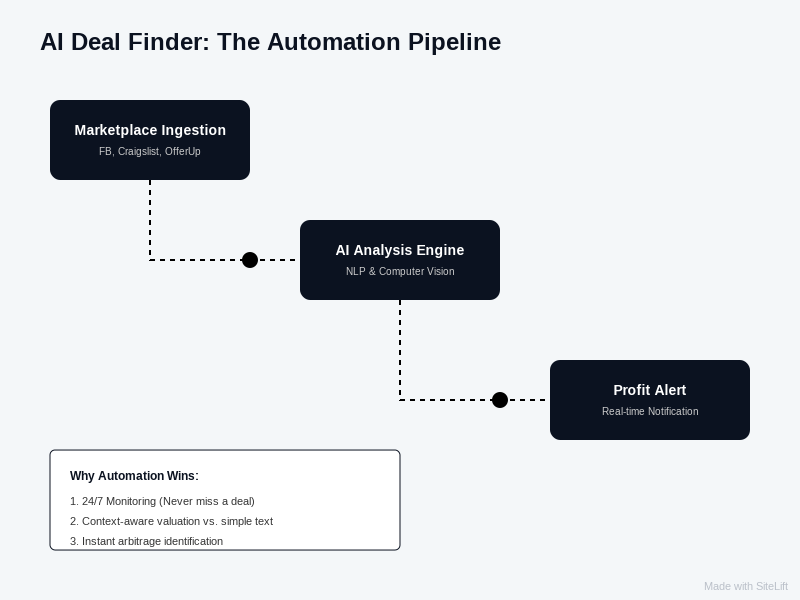
Infographic by SiteLift
Mid-Century Modern and Solid Wood Furniture
Bulky, local-pickup goods offer some of the highest dollar-per-hour returns in the reselling world. Why? Because Amazon cannot deliver a 1960s teak credenza in two days, and shipping furniture across the country via freight is expensive. Local marketplaces create a natural logistical barrier that protects your margins.
According to research published in the annual ThredUp Resale Report, the broader secondhand market is accelerating rapidly, projected to hit $350 billion globally by 2028. High-quality home furnishings are a major driver of this growth as consumers turn away from disposable "fast furniture."
Watch for brands like Herman Miller, Knoll, Lane, Drexel, and Danish makers. When sellers downsize, they frequently list these heavy solid-wood items at rock-bottom prices just to clear out a living room. An AI tool that reads wood grain and joinery styles from photos gives you an enormous edge.
Consumer Electronics, High-End Audio, and Camera Gear
Tech gear moves fast, liquidates cleanly, and carries well-documented comp data across eBay, Swappa, and Mercari.
Target categories include:
- Mirrorless Cameras and Lenses: Sony E-mount, Canon RF, Fujifilm X-series.
- Vintage Audio: Marantz, Pioneer, McIntosh receivers, and high-end turntables.
- Pro Audio / Music Gear: Synthesizers, guitar pedals, drum machines, and audio interfaces.
Sellers often unload these items after abandoning hobbies or upgrading setups, frequently pricing them hundreds of dollars below market value. Because model numbers are standardized, an ai deal finder can verify historical sold data instantly, letting you pull the trigger with complete confidence in your margins.
Designer Apparel, Vintage Streetwear, and Collectibles
The fashion recommerce sector represents one of the largest segments of peer-to-peer commerce. A consumer survey conducted by eBay Inc. found that over 80% of Gen Z and Millennial respondents have purchased pre-owned goods, using resale to find unique vintage items or generate supplemental income.
On platforms like Vinted and OfferUp, sellers constantly mislabel high-end apparel:
- Listing Japanese selvedge denim simply as "men's jeans."
- Tagging vintage single-stitch band tees as "old concert shirts."
- Pricing luxury outdoor gear (Arc'teryx, Patagonia, Stone Island) at thrift-store prices.
Using image recognition to parse brand tags, RN numbers, and embroidery, machine learning tools highlight underpriced clothing deals before they get scooped up.
Key Takeaways: Manual Sourcing vs. AI Deal Finders
To visualize how automated deal alerts alter the reselling workflow, consider the practical differences:
| Metric / Dimension | Traditional Manual Flipping | Flipping with an AI Deal Finder |
|---|---|---|
| Daily Sourcing Time | 2 to 4 hours of active scrolling | 5 to 10 minutes (reviewing alerts only) |
| Alert Latency | 30 to 120 minutes (native app alerts) | Under 60 seconds (direct push/webhook) |
| Search Accuracy | Dependent on exact keywords | NLP-driven (catches typos, vague titles) |
| Image Analysis | Manual inspection of every photo | Computer vision flags brands & tags automatically |
| Marketplace Coverage | 1 or 2 apps checked inconsistently | Cross-platform scraping running 24/7 |
| Average Margin Quality | Mixed; often compressed by late arrival | High; first-mover advantage on underpriced listings |
Pro Tip: Never rely entirely on computer vision for final authentication of luxury goods. Use the AI alert to secure the pickup window first, then run formal authentication (checking date codes, stitching, and hardware) in person before handing over payment.
Why Speed-to-Lead Beats Deep Price Haggling
Here is an opinion that runs counter to conventional reselling advice: Stop wasting your energy trying to grind sellers down on price.
In the world of high-margin flipping, aggressive lowballing is a rookie trap. When an AI alert pings you with a $600 espresso machine listed for $75, your job is not to offer $50 to save an extra twenty bucks. Your job is to lock down the deal instantly at the asking price before someone else offers full cash.
When sellers list items drastically below market value, they usually care about three things:
- Getting rid of the item today.
- Avoiding back-and-forth messaging.
- Dealing with a polite, reliable human who shows up on time.
When you offer full asking price immediately, confirm a specific pickup window, and communicate professionally, you stand out from the sea of flakes and lowballers flooding their inbox. You win deals not because you squeezed the seller for every cent, but because your ai deal finder gave you the speed advantage needed to be first in line with a frictionless transaction.
— findandflip.io
Streamline Your Sourcing Pipeline with Find & Flip
If you are ready to stop wasting hours refreshing local feeds and let automation do the heavy lifting, you need a sourcing engine built specifically for modern flippers.
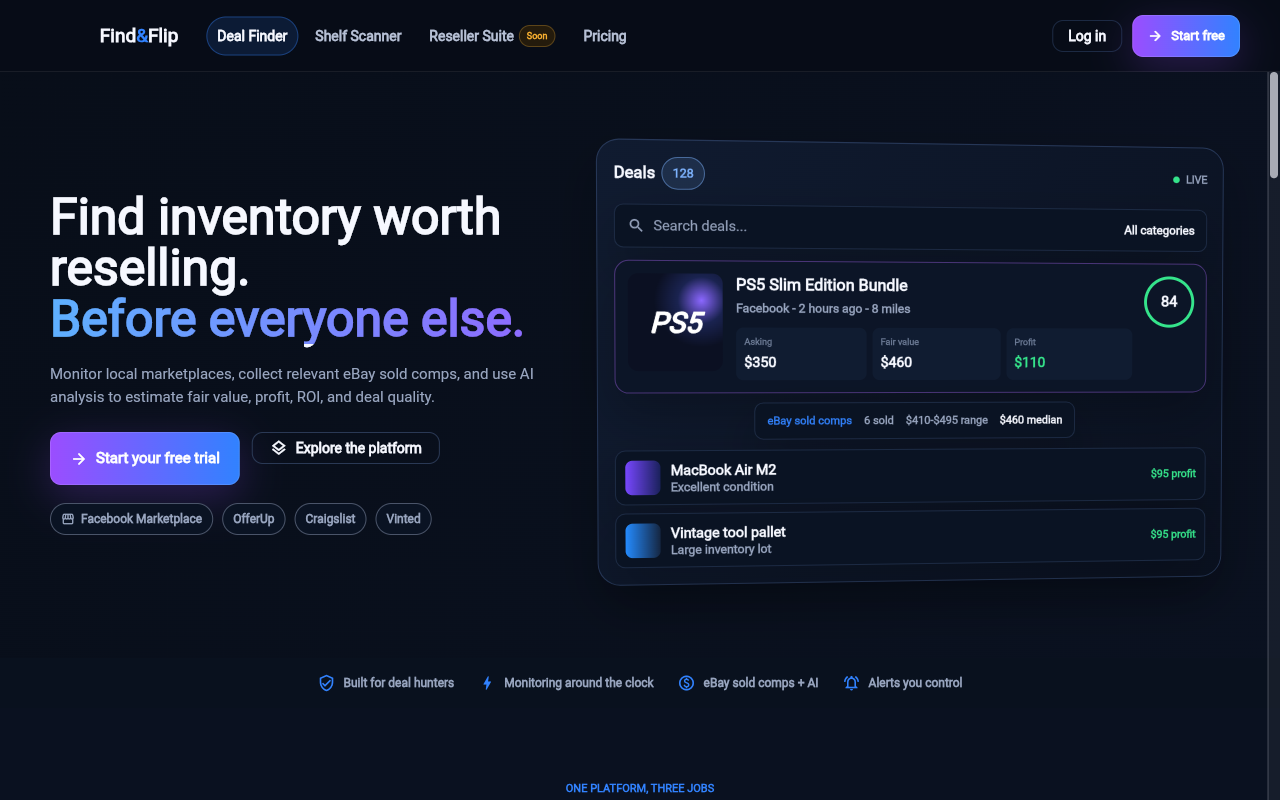
At findandflip.io, we built an intelligent marketplace deal discovery platform that monitors secondary marketplaces like Facebook Marketplace, Craigslist, OfferUp, and Vinted in real time.
By pulling disparate feeds into a single, high-speed dashboard, Find & Flip tracks historical sold comps, scores deals based on actual profit potential, and surfaces mispriced listings before they disappear. Whether you run a full-time reselling business or want to turn weekend picking into a high-margin side hustle, explore our pricing plans to find the right automated sourcing setup for your goals.
Frequently Asked Questions About AI Deal Finders
What is an AI deal finder?
An AI deal finder is software that uses web scraping, natural language processing, and computer vision to monitor online marketplaces for underpriced items. It automatically evaluates listings against historical sales data and alerts resellers to profitable flips in real time.
How fast are automated deal alerts compared to native marketplace notifications?
Native marketplace alerts from platforms like Facebook Marketplace or OfferUp often batch notifications, delivering them anywhere from 15 minutes to several hours after an item goes live. A dedicated AI deal finder scans feeds continuously, pushing notifications to your phone within 30 to 60 seconds of publication.
Is it against marketplace terms of service to use automated deal finders?
Most AI deal finders operate by monitoring public listing feeds and aggregating open web data. While marketplaces generally restrict unauthorized direct access to their private back-end systems, aggregators that surface publicly available deals for personal purchasing comply with standard web data gathering practices. Always review individual platform guidelines regarding automated messaging tools.
Can an AI deal finder determine if an item is authentic?
While AI deal finders use optical character recognition (OCR) and computer vision to identify maker's marks, logos, and model tags, they cannot guarantee 100% authenticity for counterfeit-heavy luxury goods like designer handbags or high-end watches. Use the alert to secure the first-message advantage, then perform physical authentication checks in person before completing the transaction.
How much profit margin should I target when setting up alert filters?
For local pickups involving bulky goods like furniture, aim for a minimum net profit spread of $100 to $150 to account for fuel and transportation effort. For easily shippable consumer electronics or designer clothing, target items priced at a 50% to 70% discount against verified eBay sold comps, with a minimum net spread of at least $40 to $50 after platform fees and shipping costs.