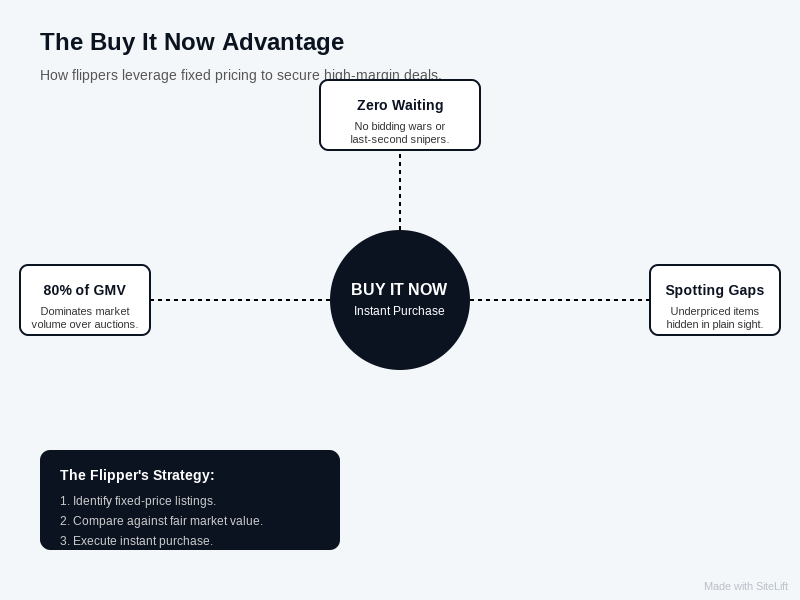
If you've ever lost an auction in the last 10 seconds, you already understand why I love the buy it now price. It's simple: the seller names a fixed number, you click, you pay, it's yours. No bidding war, no waiting five days, no sniper stealing it at 2 a.m.
For flippers, that instant-purchase option is where the real money hides. Auctions tend to settle at fair market value because everyone can see them. Fixed-price listings? They can sit wildly underpriced for hours because the seller just wants it gone. Learning to spot those gaps fast is the entire game.
What Is a Buy It Now Price and How Does It Work in Online Marketplaces?
A buy it now price is a fixed, upfront asking price that lets a buyer purchase an item immediately without bidding or negotiating. On most reselling platforms, hitting that button ends the listing on the spot.
According to eBay Inc. financial disclosures, fixed-price (Buy It Now) listings account for over 80% of total Gross Merchandise Volume (GMV) on the platform. That shift makes sense. Research from the National Retail Federation highlights that over 60% of online shoppers prefer instant purchasing over waiting for auction outcomes, a preference you can read more about in National Retail Federation research on consumer shopping behavior.
In other words, auctions get the attention, but instant purchase drives the volume.
The Mechanics of Fixed-Price vs. Auction Listings
Here's the practical difference:
- Auction listing: Seller sets a low starting bid and a duration, usually 3, 5, 7, or 10 days. Buyers bid it up. The highest bid at the end wins.
- Fixed-price / Buy It Now listing: Seller sets one price. First buyer to click and pay gets it. Listing ends immediately.
eBay also allows hybrids. A seller can start an auction with a buy it now price added on top. If someone clicks Buy It Now before any bids are placed, the auction ends. Once a bid is placed, the Buy It Now option typically disappears.
eBay explains this setup in detail in its eBay guide to Buy It Now and Best Offer options.
Why do sellers choose fixed pricing? Usually for one of three reasons:
- Need for speed. Moving sale, storage unit cleanout, business liquidation. Cash today beats an extra $30 next week.
- Certainty. They know what they want and don't want to gamble on bidding activity.
- Lack of research. This is the one flippers care about. The seller guesses at value, copies a low comp, or prices from memory from five years ago.
How 'Buy It Now' Works Across eBay, OfferUp, and Facebook Marketplace
The label changes slightly by platform, but the logic is the same.
eBay: The classic Buy It Now button. Sellers can also add Best Offer, which means the buy it now price is the ceiling, but they'll review lower offers. You can buy instantly or send an offer and wait, usually up to 48 hours.
Facebook Marketplace and OfferUp: There's no formal auction system. Almost everything is effectively a buy it now price — it's listed at $150, first person to show up with $150 gets it. The twist is negotiation is culturally expected, even if the listing says firm.
Craigslist and Vinted: Same idea. Fixed asking price, instant first-come deal. On Vinted, buyers can hit Buy Now and pay through the platform, with shipping labels generated automatically.
For a flipper, that means your competition isn't just other bidders. It's everyone scrolling at that moment.
BIN vs Auction Flipping: Is a Buy It Now Price Better for Resellers?
Short answer: for most resellers doing volume, yes. Let's talk BIN vs auction flipping honestly.
Auctions feel exciting, but excitement is bad for profit. When an auction runs for seven days, it gets watched, shared, and bid up to its true value. By day seven, 15 vintage Pyrex collectors have all found it. You won't steal it.
A mispriced fixed listing is the opposite. It rewards speed and knowledge, not patience.
Speed to Market and Capital Velocity
Flipping is a cash-flow business. If your $400 is locked in a 7-day auction you're hoping to win, that money isn't working.
With a buy it now price, the timeline looks like this:
- Spot underpriced listing at 9:03 a.m.
- Buy it at 9:04 a.m.
- Clean, photograph, and relist by that evening
- Sold and paid within 7-14 days
That velocity matters more than squeezing an extra $20 on one item. Pro flippers would rather make $80 profit three times in a month on the same $300 than make $120 once.
Eliminating Bidding Wars and Auction Snipers
Auctions have a structural problem for buyers: price discovery. The longer an item is visible, the closer the final bid gets to full retail.
Fixed-price listings have no price discovery. If a seller lists a $300 DeWalt miter saw for $95 because her husband said "just get it out of the garage," the first knowledgeable buyer wins. The tenth buyer never even sees it.
| Factor | Buy It Now (BIN) | Auction |
|---|---|---|
| Time to acquire | Instant, minutes | 3-10 days + risk of losing |
| Price potential | Can be far below market if mispriced | Usually rises to market value |
| Competition | Whoever sees it first | Everyone watching + snipers |
| Best for | Fast flips, misprints, motivated sellers | Rare, one-of-a-kind items with uncertain value |
| Flipper control | High — you decide in seconds | Low — you wait and hope |
Pro Tip: I use auctions to research and BIN to buy. Watch auctions to learn true market value, then hunt that same item as a fixed-price listing elsewhere.
How Do You Spot an Undervalued Buy It Now Price Before Other Flippers?
This is where undervalued buy it now deals separate hobbyists from full-time resellers. You aren't looking for "good deals." You're looking for pricing mistakes you can recognize in under 60 seconds.
I run every potential flip through a 3-filter check: Is it mispriced, is it real, and can I sell it fast?
Capitalizing on Seller Pricing Errors and Misspellings
Motivated sellers make predictable mistakes. Watch for:
- Garage-clearing language: "Must pick up today," "moving out," "make offer, need gone," "selling for my dad." Urgency equals leverage.
- Wrong category or bad title: A "Sony game" that is actually a PS5 disc edition, a "leather coat" that is a Schott Perfecto, a Herman Miller chair listed under "office stuff." Bad titles mean fewer eyeballs.
- Stock photos or one blurry photo: Most buyers scroll past. If you can identify the model from a knob, tag, or plug shape, you have an edge.
- Misspellings: Search for them too. Labuton for Louboutin, Rolex spelled correctly but Submariner as "submariner watch men blue." On eBay, a misspelled listing won't show up in most saved searches.
- Bundle pricing: Five power tools for $200 total. Sellers average down the value. Flippers break up the lot and sell individually.
Seasonality creates errors too. Sellers dump snowblowers in April and patio sets in October at a steep discount. If you have storage, that's free margin.
How to Price Flips Fast Using Market Comps
You don't have time for a spreadsheet when a $50 Dyson is sitting live. You need to know how to price flips fast using sold comps.
Forget active listings. Anyone can ask $400. What matters is what actually sold and paid.
My 60-second comp routine on eBay:
- Search the exact model + condition, e.g., "Dyson V11 Torque Drive used"
- Tap Filter > Show only > Sold items
- Sort by Recently sold
- Look at the last 5-10 sales, ignore outliers (broken, parts-only, new-in-box)
- Take the median sold price, subtract ~13% for eBay fees + shipping, subtract your buy cost
If that math leaves 40%+ margin, buy first and think later.
Example: Buy it now price is $60. Recent solds cluster around $165 used. After fees and $15 shipping, you net about $128. That's ~$68 profit before gas. Easy yes.
For a deeper walkthrough of this math, see this guide to evaluate marketplace deals with sold comps — it breaks down condition adjustments and downside testing.
Pro Tip: Save a note on your phone with your top 20 bread-and-butter brands and their average used sold price. When you see a buy it now price, you won't need to look it up — you'll just know.
Infographic by SiteLift
Here’s a quick decision table I use in the field:
| Buy It Now Price vs. Median Sold | Action |
|---|---|
| < 30% of sold value | Buy instantly if not broken/stolen. Verify after. |
| 30-50% of sold value | Strong flip. Check comps for 60 seconds, then buy. |
| 50-70% of sold value | Possible flip only if local pickup, no shipping, fast seller. |
| > 70% of sold value | Pass unless you can negotiate with Best Offer. |
Data from Statista shows that the US secondhand and resale market is projected to exceed $100 billion in total market value by 2026, which you can explore further in Statista data on the secondhand resale market. More buyers means comps stay strong — but also means good BIN deals vanish in minutes.
What eBay Buy It Now Strategy Actually Works for Maximum Profit?
An ebay buy it now strategy isn't about browsing. It's about being first. On eBay, profitable fixed-price items often sell within 15 minutes of listing, especially in hot categories like sneakers, video games, power tools, and vintage tees.
You need system, not luck.
Leveraging the 'Best Offer' Option on Fixed-Price Items
See a buy it now price with a Make Offer button? That price is just the starting point.
Sellers who enable Best Offer are telling you they're flexible. Here's how I play it:
- If the buy it now price is already 50% of value, just buy it. Don't risk losing it over $10.
- If it's at 70-80% of value, offer 55-60%. Many sellers auto-accept or counter within hours.
- Always check the listing history. If it's been sitting 30+ days, offer aggressively. Stale inventory makes sellers anxious.
- Be polite and fast on messages: "I can pick up today with cash, would you take $X?" Speed closes.
Don't lowball absurdly on a fresh listing. You'll just annoy the seller and get blocked. Save the 40%-off offers for items listed over two weeks.
You can learn the exact rules for offers, auto-accept thresholds, and expiration in eBay's guide to searching and filtering sold listings.
Setting Up Real-Time Alerts for Newly Listed BIN Items
Manual refreshing won't cut it. Set traps:
- eBay Saved Searches with push alerts: Create hyper-specific searches like "Herman Miller Aeron size B" + filter Buy It Now + Condition Used + Sort: Newly Listed. Turn on notifications.
- Facebook Marketplace keyword alerts: Save searches for "moving sale," brand names, and common misspellings in your zip radius. Check 3x daily — morning, lunch, and 9 p.m. when new posts spike.
- OfferUp followed searches: Same approach. Enable instant notifications for your money categories.
- Speed checkout: Keep payment methods, address, and messages pre-saved. On Marketplace, have a copy-paste message ready: "Hi! Is this available? I can come today with cash."
The goal is to cut your reaction time from 30 minutes to 30 seconds.
What Tools Help You Catch BIN Bargains Automatically?
You can't watch four marketplaces 24/7. Automation can.
Cross-marketplace aggregators pull new fixed-price listings from Facebook Marketplace, OfferUp, Craigslist, and eBay into one feed, flag items priced below eBay sold comps, and score the deal. Instead of opening 20 tabs, you see one ranked list: estimated value, asking price, profit gap, and sell-through rate.
That's exactly what tools like the Find & Flip reseller suite for spotting undervalued deals are built for — eBay sold comps, fair value estimates, and deal scoring in one place. If you source from your phone in the field, the Find & Flip browser extension for instant deal checks helps you validate a buy it now price before someone else grabs it.
The second piece is liquidity. BIN deals reward buyers with cash ready.
- Keep a dedicated flipping fund, even $300-$500 to start, in Venmo, Cash App, or PayPal.
- Set a max buy rule: e.g., never spend over $200 without checking solds, but auto-buy anything under $50 in your expert categories.
- Factor in gas, shipping supplies, and fees. A $40 profit that requires a 90-minute drive isn't a profit.
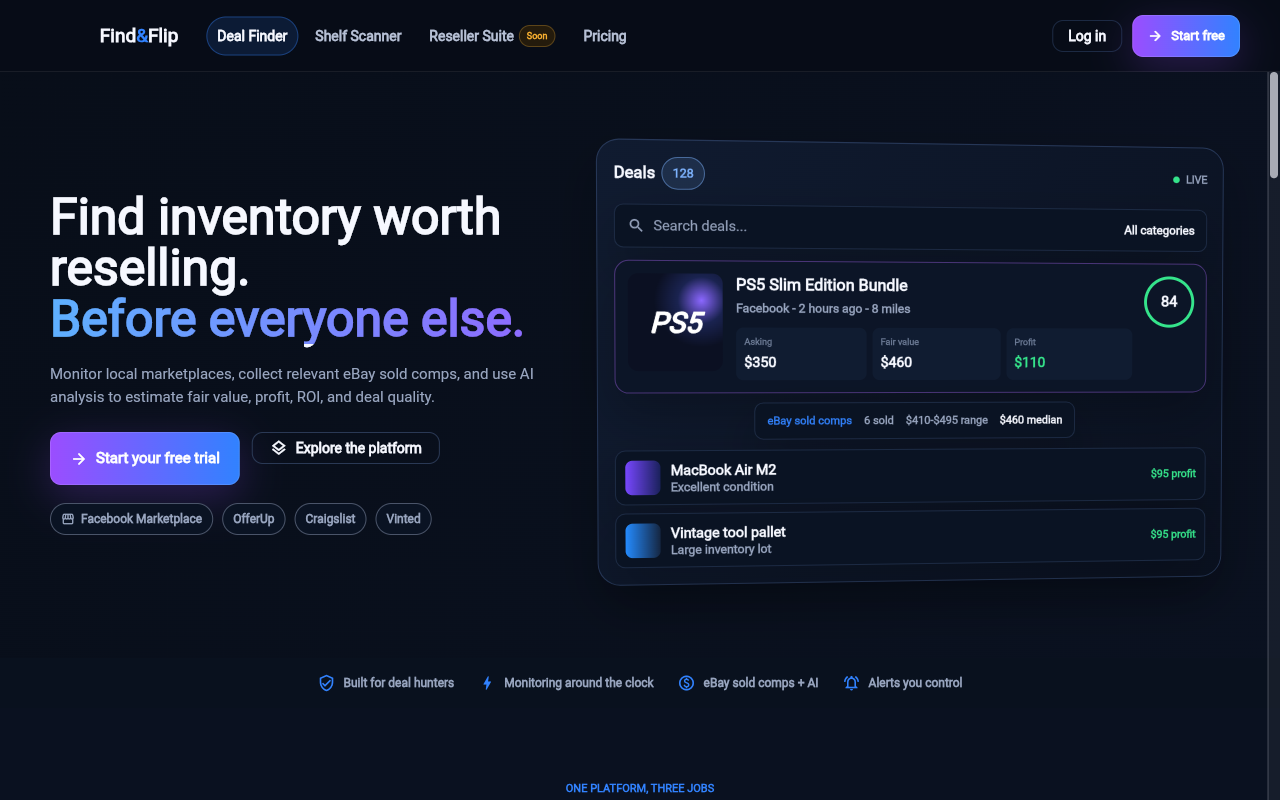
If you're tired of losing deals because you were second to message, this is where findandflip.io helps. It surfaces underpriced Marketplace listings with live eBay comps so you can decide in seconds, not after the item is marked sold.
Key Takeaways
| What You Learned | Why It Matters for Flippers |
|---|---|
| Buy it now price = instant purchase at a fixed number, no bidding needed | Speed wins. First knowledgeable buyer gets mispriced items. |
| BIN vs auction: Auctions rise to market value, BIN can stay underpriced | Target fixed listings for highest ROI and faster turnover. |
| Seller mistakes — urgency, bad titles, wrong categories, bundles | Fewer eyeballs = less competition = bigger margin for you. |
| Price flips fast with eBay Sold Items, median price minus fees/shipping | 60-second comp check prevents bad buys and missed winners. |
| eBay Buy It Now strategy: saved searches, push alerts, smart Best Offers | Being first within minutes beats being smart hours later. |
| Automation + ready cash across eBay, FB Marketplace, OfferUp | Aggregators + liquid funds let you strike immediately. |
Why I Hunt Buy It Now Prices First: My Honest Take
I'll be blunt: I almost never win auctions anymore, and I don't try to.
Early on, I spent entire evenings watching auctions, setting max bids, getting sniped, feeling frustrated. I was doing free price research for sellers. Then I flipped my approach and started living in newly listed Buy It Now.
My personal rule now is simple — auctions are for learning, BIN is for earning. I check fixed-price, newly listed inventory first every morning with coffee. If I see a familiar brand at 40 cents on the dollar, I don't negotiate, I don't ask for more photos, I buy it and figure out the details in the car.
Is it riskier? Sometimes. I've bought a "tested" speaker that was blown and a "leather" bag that was definitely plastic. But my hit rate is way higher because I'm only buying in categories where I know comps cold: mid-century smalls, DeWalt/Milwaukee tools, and vintage Carhartt.
If you're starting out, pick three categories and memorize them. You'll spot an undervalued buy it now price faster than any scanner because you'll feel when the number is wrong. That instinct, plus alerts and quick comps, is unbeatable.
— findandflip.io
FAQ
What does Buy It Now price mean on reselling platforms?
A Buy It Now price means you can purchase the item immediately at the listed price without bidding. On eBay, clicking Buy It Now ends the listing instantly. On Facebook Marketplace, OfferUp, and Craigslist, the asking price works the same way — first buyer to pay or pick up gets it, though negotiation is common.
Is Buy It Now better than auction listings for flippers?
For most flippers, yes. Auctions expose an item to the whole market for days, so final bids usually climb to full market value. A buy it now price can remain severely underpriced if the seller needs fast cash, miscategorizes the item, or doesn't research value. That lets fast, knowledgeable buyers capture the margin.
Can you negotiate a Buy It Now price on eBay or OfferUp?
Often, yes. On eBay, if you see a Make Offer button next to the Buy It Now button, the seller accepts negotiations and may have auto-accept rules. On OfferUp and Facebook Marketplace, almost every fixed price is negotiable unless it says firm. Polite, fast offers with same-day pickup get accepted most often.
How do flippers evaluate sold comps quickly before a Buy It Now deal disappears?
They ignore active listings and check eBay Sold Items only. Search the exact model, filter to Sold, sort by recent, and look at the last 5-10 sales for a median price. Subtract fees (around 13%), shipping, and the asking price. If 35-40%+ profit remains and sell-through is strong, they buy immediately.