
If you treat reselling as a business rather than an occasional closet cleanout, your choice of platform directly controls your bottom line. Every wasted message, cancelled meetup, and platform fee bites into your net hourly return. In the battle of OfferUp vs Facebook Marketplace, flippers are caught between two local commerce giants that look similar on the surface but function completely differently under the hood.
According to OfferUp's Recommerce Report, over 85% of Americans engaged in buying or selling pre-owned goods in 2023. Meanwhile, data from Statista shows that the US secondhand and recommerce market is projected to reach over $70 billion by 2027. Sourcing undervalued goods and flipping them for 50% to 200% margins is more lucrative than ever. But spending your precious weekend hours fielding automated "Is this available?" spam on the wrong platform will kill your momentum.
Let's break down how these two applications stack up so you can decide which one deserves your best inventory.
OfferUp vs Facebook Marketplace: At-a-Glance Comparison
Before diving into the mechanics, here is how the two platforms compare on the metrics that matter most to professional flippers:
| Evaluation Metric | OfferUp | Facebook Marketplace | Winner |
|---|---|---|---|
| Active User Base | Primarily US mobile users; concentrated in metro areas | Massive global scale; ubiquitous across US suburbs and cities | Facebook Marketplace |
| Local Pickup Fees | $0 (Free cash/in-person transactions) | $0 (Free cash/in-person transactions) | Tie |
| Shipping Fees | 12.9% of sale price (minimum $1.99) paid by seller | 5% standard selling fee ($0.40 minimum) for shipped orders | Facebook Marketplace |
| Buyer Communication | In-app messaging, structured offer buttons | Facebook Messenger tied to personal profiles | Facebook Marketplace |
| Seller Anonymity | High (screen names, avatar photos) | Low (tied directly to personal Facebook profile) | OfferUp |
| Identity Verification | TruYou badge (ID + selfie verification) | Account age, public profile history, mutual friends | OfferUp |
| Search Discovery Speed | Keyword-driven, reverse-chronological | Heavy algorithmic recommendations based on browsing | Tie (Varies by goal) |
| Flake Rate | High among non-verified buyers | Moderate to High (mitigated by real profiles) | Facebook Marketplace |
Core Evaluation Criteria: How We Compare Resale Platforms
To make a fair marketplace comparison for sellers, we ignore surface-level vanity metrics. We evaluate these platforms across four pillars that make or break a flipping business:
- Audience Reach and Demographic Depth: You need paying buyers with disposable income, not just passive window shoppers. The demographic profile of a platform determines how much cash a buyer will hand over for a restored mid-century modern credenza versus an unboxed power tool.
- Fee Structures and Net Margins: Cash-in-hand local pickups are standard across classifieds, but shipping expands your pool of buyers. High take-rates instantly eliminate low-margin inventory.
- User Interface and Discovery Velocity: As a flipper, you wear two hats: sourcer and seller. The app must allow you to find mispriced bargains within seconds of listing, while also exposing your flipped inventory to buyers searching for those exact items.
- Safety, Trust, and Scam Mitigation: Meeting strangers in parking lots carries real risks. Verified identities, clear user ratings, and solid transaction safeguards are non-negotiable.

OfferUp Analyzed: The Dedicated Mobile Flea Market
OfferUp emerged as the mobile-first heir to Craigslist, absorbing its primary competitor, Letgo, to solidify its position as the premier dedicated classifieds app in the United States. It functions like an endless, digital garage sale.
OfferUp Workflow:
[Snap Photos] ➔ [Set Cash Price] ➔ [Receive In-App Bids] ➔ [Meet at Safe Location]
Audience Scale and In-App Behavior
OfferUp caters to a younger, mobile-first demographic. The app thrives on quick, impulse-driven local commerce. Buyers on OfferUp are habitual bargain hunters. They rarely pay full asking price, and they expect you to haggle.
Because user accounts are not tethered to personal social profiles, the community has a casual flea-market culture. Buyers frequently throw lowball numbers through the built-in "Make Offer" tool. However, because it is a dedicated shopping app, anyone opening OfferUp is already in buying mode. You rarely deal with casual scrollers who tapped an item by accident.
OfferUp Reselling Guide: Fee Breakdown and Shipping Limits
For local pickups where the buyer hands you cash or uses a peer-to-peer payment app, OfferUp charges $0. This makes it an outstanding tool for keeping 100% of your gross margins on bulky, heavy, or quick-turn items.
When you offer nationwide shipping, the economics shift:
- Seller Fee: OfferUp takes 12.9% of the final sale price, or a flat minimum fee of $1.99.
- Shipping Labels: The buyer typically pays for the shipping label, which OfferUp provides via USPS.
- Weight Limits: Shipped items cannot exceed 20 pounds or have dimensions larger than 108 inches (length + girth combined).
A 12.9% cut is steep for local classifieds, bringing it closer to eBay's fee tier without offering eBay's international buyer reach.
Search Engine Quirks and Finding Undervalued Gems
From a sourcing perspective, OfferUp's search algorithm remains delightfully basic. It relies primarily on exact keyword matches, location radiuses, and chronological recency.
This is a massive advantage for experienced resellers. When someone cleans out a deceased relative's estate and lists a "vintage brown wooden chair" for $20, OfferUp does not attempt to deduce that it is an authentic Herman Miller lounge. It simply shows you the listing because you searched "chair" within 5 miles. Savvy flippers who know their niches can find incredible mislabeled inventory before the seller realizes what they own.
Pro Tip: Set saved alerts on OfferUp for vague, misspelled terms like "vintige," "gameing," or generic phrases like "garage cleanout." Casual sellers who misspell titles leave thousands of dollars on the table.
OfferUp Pros and Cons
Pros:
- Complete anonymity; no connection to your family, employer, or personal social media.
- Built-in TruYou verification (requiring a state ID scan) weeds out high-risk profiles.
- Excellent in-app counter-offer system prevents endless back-and-forth messaging.
- Direct local buyer intent—people on the app are strictly looking to trade goods.
Cons:
- Punitive 12.9% fee on shipped items eats heavily into net profit margins.
- Heavy ad clutter in the browsing feed slows down sourcing speed.
- Significantly smaller total user base outside major metropolitan areas.
Facebook Marketplace Analyzed: The Social Commerce Giant
Facebook Marketplace is not an isolated resale app; it is a feature bolted onto the world's most populated social network. According to official disclosures from Meta, over 1 billion people globally use Facebook Marketplace each month to browse, buy, and sell items. That unmatched sheer volume fundamentally changes resale dynamics.
The Power of Meta’s Massive Local User Base
Marketplace's greatest strength is friction-free adoption. Your prospective buyers do not need to download an obscure mobile app, remember a login, or set up a new account. They are already on Facebook checking community news, neighborhood groups, and family updates.
This dynamic gives Marketplace unparalleled reach into older, higher-income demographics. Suburban homeowners with substantial disposable income use Facebook Marketplace daily. If you are selling high-end furniture, boutique home decor, or premium exercise gear, Marketplace gives you access to buyers who will pay market rates without demanding a 50% discount.
Facebook Marketplace Fees, Shipping, and Local Selling Rules
Facebook Marketplace offers some of the most competitive fee structures in the recommerce ecosystem:
- Local Transactions: Completely free (0%) when you coordinate local cash pickups.
- Shipped Transactions: Meta standardizes fees at 5% per transaction (or a flat $0.40 for shipments under $8.00).
A 5% shipping fee is less than half of OfferUp's 12.9% rate. For items small enough to box up—such as vintage apparel, video game consoles, or rare collectibles—Facebook Marketplace lets you keep significantly more profit.
Shipping Fee Comparison (Example: $100 Sale)
---------------------------------------------
OfferUp Take Rate (12.9%):         -$12.90
Facebook Marketplace Take Rate (5%): -$5.00
Net Margin Advantage for Facebook:  +$7.90 per item
Algorithmic Sourcing: Why the Feed Shows You High-Margin Flips
Unlike OfferUp's rigid keyword feed, Facebook Marketplace uses Meta's recommendation engine. The more you click on mid-century dressers, broken MacBooks, or vintage stereo receivers, the more Marketplace curates your home feed to present those exact items.
This algorithmic curation creates a continuous stream of profitable sourcing opportunities. Sellers who have zero idea what their items are worth will upload them under categories like "Miscellaneous," and Facebook's image-recognition software will frequently drop those listings directly into your feed because it knows your viewing habits.
Facebook Marketplace Pros and Cons
Pros:
- Massive reach across suburban, urban, and rural markets.
- Industry-low 5% fee for shipped items keeps profits in your pocket.
- Meta's visual recommendation engine serves high-margin sourcing deals on auto-pilot.
- Integrated with Facebook Messenger, letting you vet buyer profiles for authenticity.
Cons:
- Rampant automated spam ("Hi, is this still available?") wastes substantial time.
- Tying sales to your personal Facebook account reduces privacy.
- The desktop and mobile interfaces are notoriously buggy, with listings occasionally disappearing without explanation.
Head-to-Head Showdown: OfferUp vs Facebook Marketplace
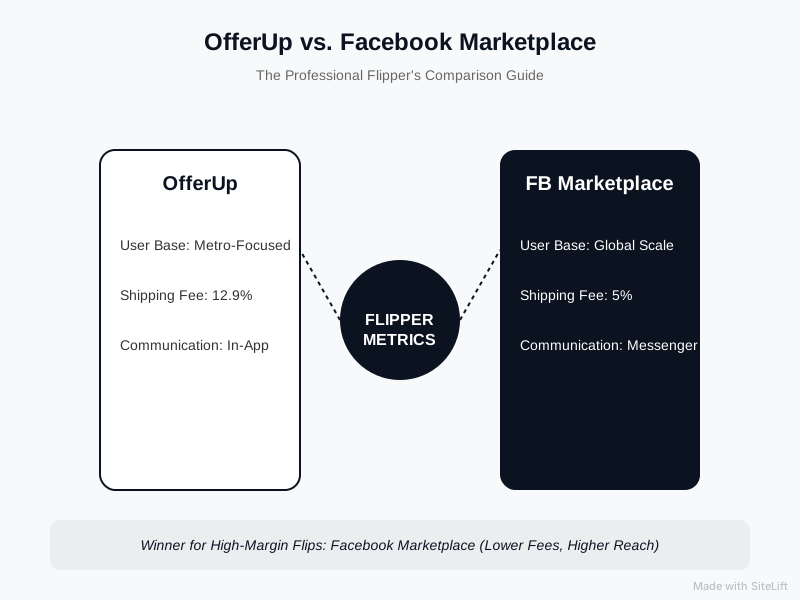
Infographic by SiteLift
When comparing the two platforms side-by-side, certain operational patterns emerge for professional flippers.
1. Fees and Profit Preservation
- Winner: Facebook Marketplace
While both platforms are free for local cash sales, Facebook Marketplace's 5% shipping fee beats OfferUp's 12.9% cut. If you ship $2,000 worth of merchandise a month, choosing Facebook Marketplace over OfferUp saves you roughly $158 every single month in platform overhead.
2. Sourcing Speed and Discovery
- Winner: Tie (Depends on flipping style)
If your strategy relies on misspelled listings and keyword hunting, OfferUp's chronological, keyword-faithful search lets you find deals without algorithmic interference. If your strategy relies on volume discovery, Facebook Marketplace's predictive feed brings deals to your screen before you even type a search query.
3. Buyer Quality and Transaction Velocity
- Winner: Facebook Marketplace
OfferUp suffers from high buyer drop-off. It is easy for an anonymous user to make an offer and disappear. On Facebook Marketplace, because transactions are linked to real identities, buyer accountability is generally higher. Furthermore, the sheer volume of users means that correctly priced items sell within hours on Facebook, compared to days or weeks on OfferUp.
4. Safety and Scam Mitigation
- Winner: OfferUp
Both platforms have their share of bad actors attempting phone-number scams or fraudulent payment schemes. The Federal Trade Commission consistently warns consumers against sharing verification codes or accepting overpayment through peer-to-peer payment apps.
However, OfferUp handles in-person safety better. Its TruYou system verifies users through government-issued identification, and the app explicitly highlights safe transaction zones (such as local police stations and monitored grocery store parking lots) within its native map interface.
Use-Case Breakdown: Which Platform Wins for Your Niche?
The debate over the best platform for flipping comes down to the specific inventory you move. No serious reseller relies exclusively on one app for every product category.
Inventory Routing:
Bulky / High-End Furniture ──► Facebook Marketplace (Affluent Suburban Reach)
Small Electronics / Tools   ──► OfferUp (Quick Local Cash Liquidation)
Shipped Collectibles        ──► Facebook Marketplace (5% Take Rate Advantage)
Best for Furniture and Bulky Upcycling: Facebook Marketplace
Suburban homeowners decorate with Facebook Marketplace. If you are flipping dining sets, dressers, couches, or patio sets, Marketplace is the clear winner. The buyers on this platform have larger vehicles, larger homes, and more disposable income. An upcycled vintage credenza that languishes on OfferUp at $150 can routinely sell for $350 on Facebook Marketplace within 48 hours.
Best for Consumer Electronics and Power Tools: OfferUp
OfferUp is a powerhouse for consumer tech, power tools, lawn equipment, and automotive accessories. Contractors, handymen, and tech enthusiasts actively browse OfferUp for work-ready tools and hardware. The local, cash-in-hand nature of OfferUp eliminates the chargeback and return risks that plague electronics sales on platforms like eBay.
Best for Collectibles, Retro Games, and Shipped Goods: Facebook Marketplace
Because Facebook Marketplace caps its shipping fee at 5%, it is the superior platform for small, high-value goods that require a nationwide buyer pool. Combined with niche Facebook buy/sell groups, you can tap into specialized collector communities directly through your Marketplace listings.
The Hybrid Strategy: Sourcing on One, Selling on the Other
The most profitable resellers rarely pick sides. Instead, they exploit market inefficiencies between platforms:
- Source on OfferUp: Search OfferUp for quick-cash sellers, estate liquidations, and undervalued tools or furniture where the seller just wants the item gone.
- Clean, Repair, and Stage: Elevate the perceived value of the product with bright lighting, neutral staging backgrounds, and detailed dimension specs.
- Sell on Facebook Marketplace: List the item to Meta's wider, higher-income audience at full retail market value.
This arbitrage captures the price spread between an unmotivated seller on an informal app and a motivated retail buyer on an established social network.
Pro Tip: Never use screenshots or original photos from the source listing. Always take fresh, high-resolution photos against a clean background to reset the item's digital footprint and maximize your listing value.
Why Platform Diversification Is Underrated
A common mistake among new resellers is platform dogmatism. Flippers fall in love with Facebook Marketplace because of its massive view counts, only to have their account randomly shadowbanned by an automated moderation bot. If your entire sourcing and selling infrastructure lives on a single platform, an algorithmic glitch can halt your business overnight.
OfferUp offers insulation against Meta's unpredictable moderation ecosystem. Its interface may feel utilitarian, but its support channels are easier to navigate, and your account is not tied to whether you accidentally violated a social media community guideline in an unrelated comment section.
Treat every marketplace as an open storefront. Cross-listing high-ticket items across both platforms maximizes your visibility and reduces inventory holding costs, ensuring your working capital stays liquid.
Build Your Sourcing Edge with Find & Flip
Flipping profitably requires finding inventory priced well below fair market value before anyone else spots it. Manually refreshing OfferUp and Facebook Marketplace search feeds every ten minutes is an exhausting, inefficient way to source.
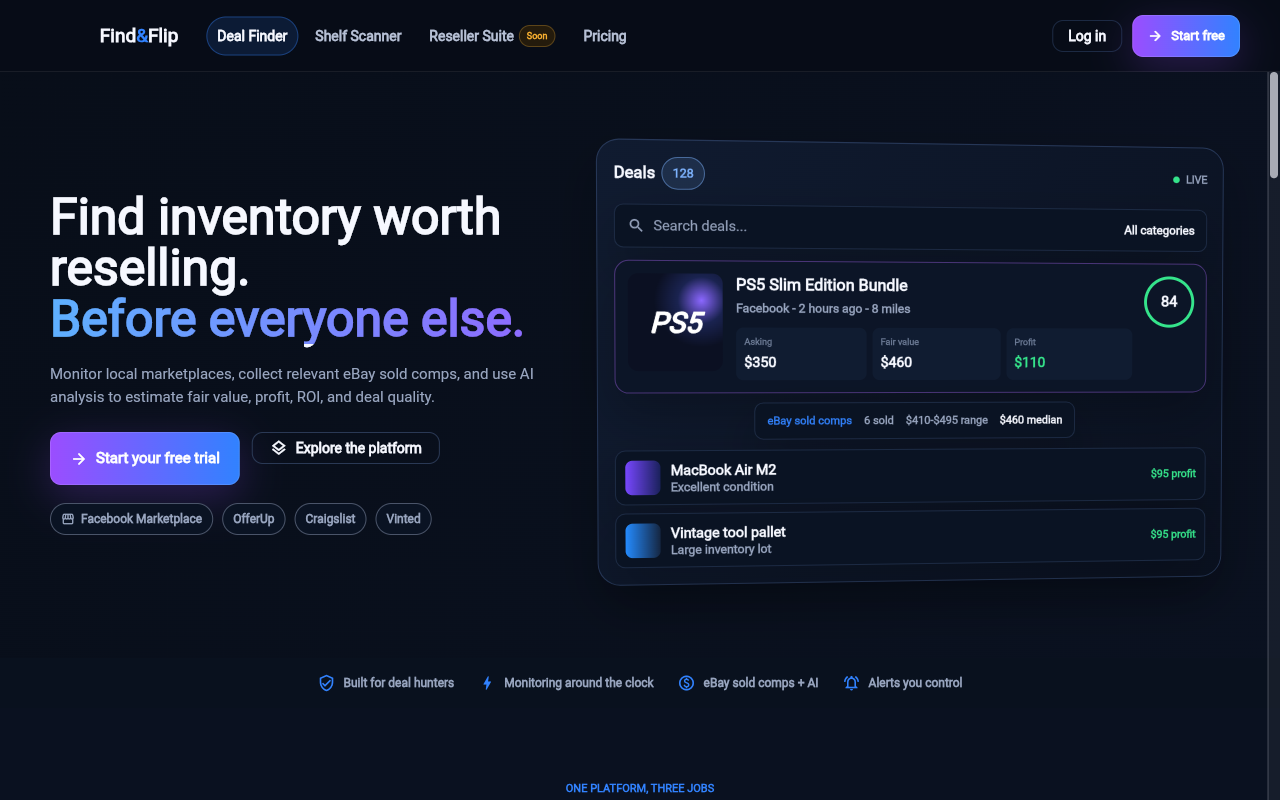
This is where findandflip.io streamlines your business. Instead of jumping between disconnected apps, Find & Flip tracks undervalued listings across major recommerce platforms in one place. By analyzing price trends, fair market value estimates, and real-time deal scoring, the platform alerts you to profitable inventory the moment it gets posted.
Whether you are looking to scale your local furniture refurbishing business or automate your electronics arbitrage, you can review our frequently asked questions to see how automated deal alerts free up your schedule. When you spend less time refreshing search bars, you spend more time closing profitable flips.
— findandflip.io
FAQ
Is OfferUp or Facebook Marketplace better for flipping furniture?
Facebook Marketplace is significantly better for flipping furniture. Its demographic skews toward suburban homeowners who have both the disposable income to pay market rates and the space to furnish. Facebook's local reach makes it easy to move large, heavy items like sectionals, dining sets, and solid wood dressers without paying listing fees.
What are the seller fees on OfferUp compared to Facebook Marketplace?
Both platforms are 100% free for local, in-person cash sales. However, for nationwide shipping, Facebook Marketplace charges a low 5% fee ($0.40 minimum), whereas OfferUp charges a 12.9% fee (minimum $1.99). Facebook Marketplace is substantially cheaper for shipped transactions.
Can you get scammed on OfferUp or Facebook Marketplace as a seller?
Yes, scam attempts happen on both platforms. The most common scams involve buyers offering to pay upfront via fake Zelle or check confirmations, or asking for your phone number to send a two-factor verification code. You can protect yourself by insisting on cash payments for in-person transactions and keeping all transaction-related communication strictly inside the apps.
Is it better to cross-list items on both OfferUp and Facebook Marketplace?
Yes. Cross-listing increases your exposure and reduces the number of days an item sits in your inventory. Just make sure to promptly delete the listing from the secondary platform the moment it sells to avoid double-selling or frustrating prospective buyers.
Why do Facebook Marketplace listings get more views than OfferUp?
Facebook Marketplace has over one billion monthly active users globally, and millions of active US accounts already have the app open every day. In addition, Meta uses advanced algorithmic recommendation feeds to suggest listings to users based on their browsing behavior, generating significantly more organic impressions than OfferUp's traditional keyword-based search.